Week 27: Serviceberry, Robin Wall Kimmerer, K.M. Wiegand
JUNE 28TH, 2026

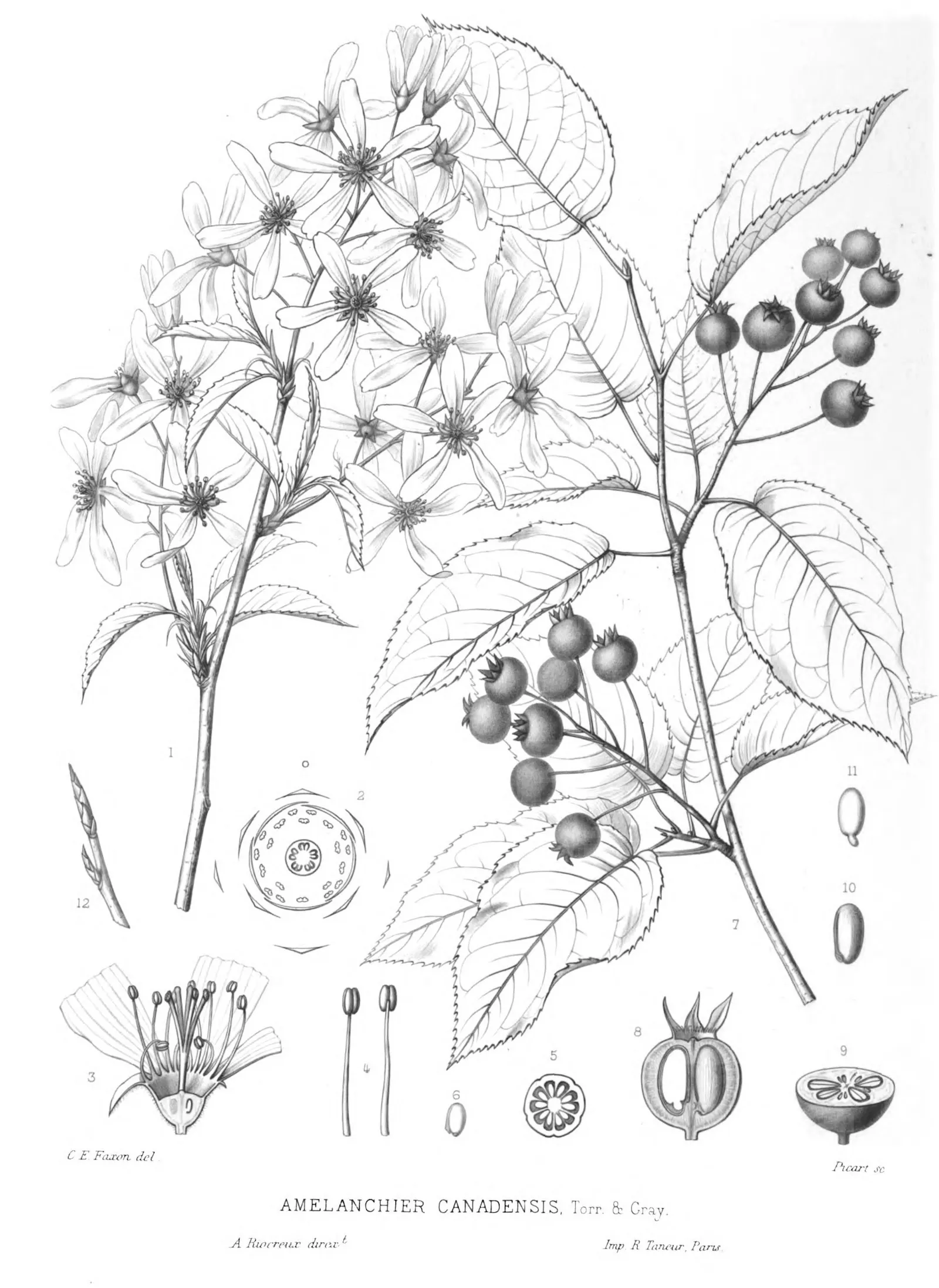
Cover Image. “Amelanchier Canadensis,” Plate CXCIV from Charles Sprague Sargent, The Silva of North America, Vol. IV: Rosaceae-Saxifragaceae(Boston: Houghton Mifflin, 1892), p. 133.
Waning Gibbous Moon; 32 Days to August Cross-Quarter Day
Headnote
It’s not every day you get to experience a new taste, a new texture—a new food—at the same time as your child, while both perched atop a long-tail cargo bicycle behind their elementary school.
We rolled up unexpecting. My son asked if they were edible, and, after I quickly confirmed on the internet that they were in fact serviceberries, we both sampled and quickly set in to munching. We rolled off a few minutes later to meet the rest of the family, sweetened and sated.
A berry in the apple family? A blueberry crossed with a cherry? “Ephemeral sips of summer,” as Robin Wall Kimmerer writes in the first reading below.
The genus Amelanchier includes more than 20 species of shrubs and small trees (or more than 80, by some counts). These go by many names regionally and linguistically: serviceberry, sugarplum, sarvis, shadbush, juneberry, saskatoon, chuckley pear, and misâskwatômin (in Cree). This abundance and variety are compounded by the genus’ penchant for cross-pollination; for the many species of Amelanchier easily hybridize with one another, creating “swarms” in which the difference between original and hybrid are blurred. They even can cross with another genus entirely, as when the Western or Saskatoon serviceberry (Amelanchier alnifolia) intermingles with a certain species of mountain-ash. And because serviceberry blossoms do not require fertilization to produce viable seeds (due to what the botanists call apomixis), these hybrids do not suffer the fate of the sterile mules; indeed, any stray cross-pollinated plant can produce a whole stand of hybrids identical to its novel self. Long botanics treatises have been written trying to make sense of the ensuing chaos, as K.M. Wiegand attests below.
Serviceberries are in the “apple subtribe” of the Rose family, along with pears, quince, aronia berries, and several other edible fruits. Because of this, the serviceberry is a pome fruit rather than a true berry, each containing several small seeds. Although these add some texture to each bite, they also impart a slight almond flavor, which is further enhanced by cooking or heating (for example, in pies and compotes). Maybe next year we will have to try our first serviceberry pie.
Fig. 2. “Amelanchier arborea (Michx. f.) Fern., downy serviceberry,” from Elbert L. Little Jr., Atlas of United States Trees, Vol. 4: Minor Eastern Hardwoods (Washington, DC: USDA Forest Service, 1976), p. 51.
Readings
- Saskatoon, Juneberry, Shadbush, Shadblow, Sugarplum, Sarvice, Serviceberry—these are among the many names for Amelanchier. Ethnobotanists know that the more names a plant has, the greater its cultural importance. The tree is beloved for its fruits, for medicinal use, and for the early froth of flowers that whiten woodland edges at the first hint of spring. Serviceberry is known as a calendar plant, so faithful is it to seasonal weather patterns. Its bloom is a sign that the ground has thawed. In this folklore, this was the time that mountain roads became passable for circuit preachers, who arrived to conduct church services. It is also a reliable indicator to fisherfolk that the shad are running upstream—or at least it was back in the day when rivers were clear and free enough to support the spawning of shad.
Calendar plants like Serviceberry are important for synchronizing the seasonal rounds of traditional Indigenous People, who move in an annual cycle through their homelands to where the foods are ready. Instead of changing the land to suit their convenience, they changed themselves. Eating with the seasons is a way of honoring abundance, by going to meet it when and where it arrives. A world of produce warehouses and grocery stores enables the practice of having what you want when you want it. We force the food to come to us, at considerable financial and ecological costs, rather than following the practice of taking what has been given to us, each in its own time. These Serviceberries were not coerced, and their carbon footprint is nothing. Maybe that’s why they taste so good—they come only this time of years—these ephemeral sips of summer, without the aftertaste of harm.
Robin Wall Kimmerer, The Serviceberry: Abundance and Reciprocity in the Natural World (New York: Scribner, 2024), pp. 9-10.
- It is with some hesitation that the writer attempts a treatment of a genus which in the past has been subject to so much difference of opinion as Amelanchier. His only excuse is that field and herbarium studies covering a period of sixteen years, but more especially of four years, have led him to conclusions in regard to specific identity, relationship, and nomenclature which differ rather widely from those generally accepted at present.
[…] The principal cause of most of the difficulty experienced by the students of Amelanchier in the past in drawing specific lines [of relationship], is to be found undoubtedly in the wonderful variability which seems to exist within the genus, a variability so extreme that rarely did it seem possible to find two plants as much alike as specific identity in other groups would demand. Indeed, if the sheets of any large collection are sorted on any assumed basis, almost as many transitional sheets will be found as sheets typical of the supposed species. For this reason many taxonomists have been inclined to believe that no real specific lines exist, at least so far as the eastern species are concerned. Because of this wealth of form two courses have seemed possible: a conservative treatment in which very few species, sometimes only one, are recognized; or a radical one in which a great many species are supposed to exist.
K.M. Wiegand, “The Genus Amelanchier in Eastern North America,” Rhodora: Journal of the New England Botanical Club 14.163 (July 1912: 117-161), pp. 117-.
Supplementum
-
Robin Wall Kimmerer, “The Serviceberry: An Economy of Abundance,” Emergence Magazine (October 26, 2022).
-
George Neville Jones, American Species of Amelanchier (Urbana: The University of Illinois Press, 1946).
-
Nina Foster, “Juneberry: A Summer Sweet for People, Pollinators, and Birds,” JStor Daily (June 27, 2025).
-
“The Berry That Lost to the Blueberry,” Grub Americana (n.d.).
-
Renée Kohlman, “Classic Canadian Dish: Saskatoon Pie,” Canadian Food Focus (n.d.).
Fig. 3. “Saskatoon Serviceberry: Transverse Section, Radial Section, Tangential Section,” from E.S. Harrar, Hough’s Encyclopaedia of American Woods (New York: Robert Speller & Sons, 1957), specimen 287.


